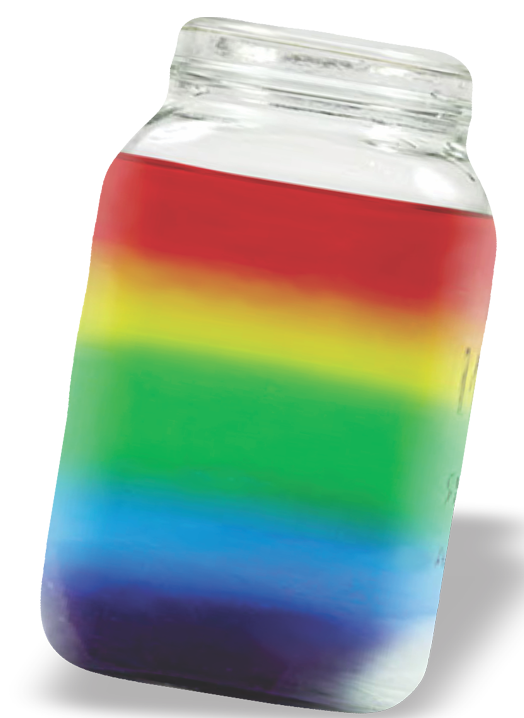
Rainbow Water
Rainbow Water is a colorful, hands-on STEM experiment that demonstrates water density by layering sugar-water solutions tinted with food coloring. As sugar concentration increases, the liquid becomes more dense—allowing students to carefully stack different densities into a visible rainbow. This activity is ideal for classrooms, outreach events, and home learning, and it includes discussion questions and extension ideas to deepen understanding of density and mixing.
Fun Facts/Information:
- Adding sugar to water increases its density.
- When liquids of different densities are carefully layered, they remain separated rather than mixing, allowing distinct colors to form a visible rainbow.
Learning Objectives:
- Use the scientific property of density to create a layered rainbow.
- Observe how changes in density affect the behavior of liquids.
Materials:
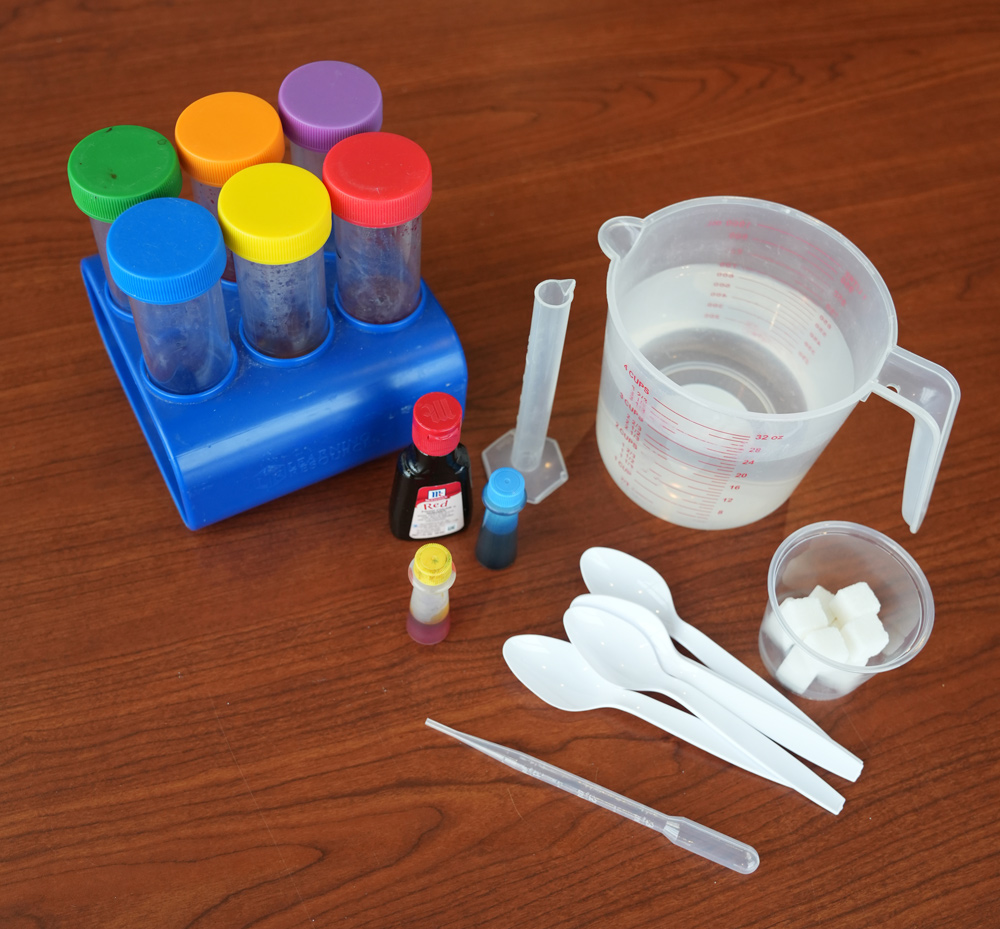
- 6 clear cups or containers
- 3 cups of warm water
- Red, yellow and blue liquid food coloring
- 5 tbsp white granulated sugar
- 5 spoons
- 1 pipette or dropper
- 1 tall, thin clear container (large test tube
Procedure:
- Fill each clear cup with ½ cup of warm water. Warm water helps the sugar dissolve more efficiently.
- Add 1-2 drops of food coloring to each cup to lightly tint the water:
- Red
- Orange (1 drop red, 1 drop yellow)
- Yellow
- Green (1 drop yellow, 1 drop blue)
- Blue
- Purple (1 drop blue, 1 drop red)
- Add sugar to each cup as follows:
- Red: No sugar
- Orange: 1 teaspoon
- Yellow: 2 teaspoons
- Green: 3 teaspoons
- Blue: 4 teaspoons
- Purple: 5 teaspoons
- Stir each cup until all the sugar is fully dissolved.
Note: Use a different spoon for each cup to avoid mixing sugar amounts. - To begin creating the rainbow, use the pipette or dropper to add 1-3 droppers of the purple liquid to the tall, thin container.
- Slowly add the blue liquid by placing the pipette close to the surface of the purple layer and gently releasing the liquid along the inside wall of the container.
- Continue layering the liquids in the following order: green, yellow, orange, and red.
- Place the container in a well-lit area or hold it up to a window or light source to observe the rainbow layers.
Discussion Questions:
- How does adding sugar to the water affect its density?
- Does the color of the water change its density?
- Are darker colors (such as blue and purple) more dense than lighter colors (such as yellow)? Why or why not?
Extensions:
- Observe the rainbow closely and identify any new colors that appear where layers meet.
- Discuss why these colors may form.
Quick Links

Where are Activities Available?
We partner with over 600 educational organizations.
See our school locator