Surface Tension
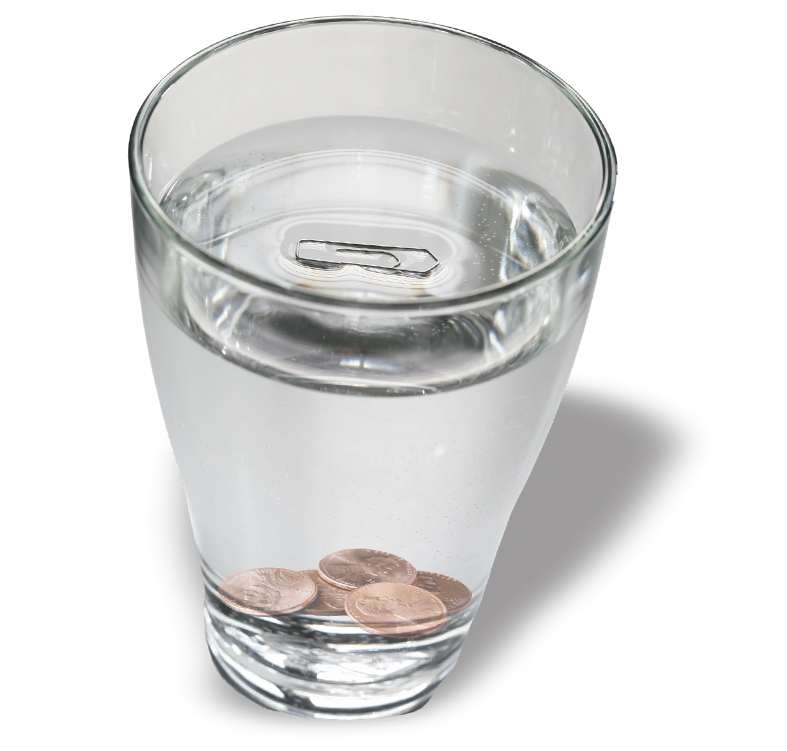
Students investigate surface tension by slowly adding drops to overfill a cup, floating a paper clip on the water’s surface, and observing how dish soap reduces surface tension and makes the object sink. Extension: count how many drops of water can sit on a penny before the surface breaks.
Fun Facts/Information:
- Surface tension is a skin-like property of liquid that most commonly occurs at the boundary between a liquid and a gas (like the surface of a lake).
- This property is what allows water striders and other insects to walk on water.
- Bubbles will always take the shape of a sphere because of surface tension.
- The reason for this is because surface tension causes liquids to minimize their surface area, and a sphere has the least surface area out of all 3D geometric shapes for a given volume.
- The term "surfactant" is a contraction for the words "surface-active agent", which is a chemical compound that weakens surface tension.
- Dish soap is an example of a surfactant.
- Dish soap is an example of a surfactant.
Learning Objectives:
- Students will use household items to experiment with the physical property of surface tension.
Materials:
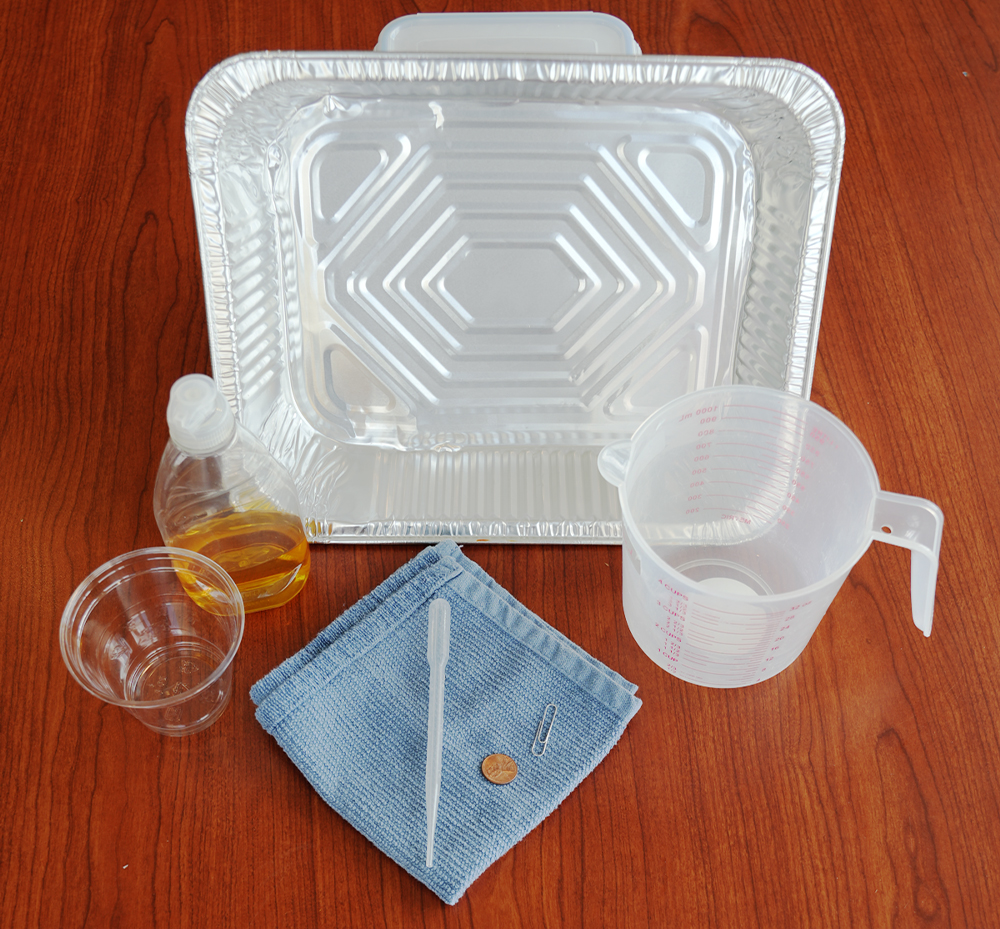
- Empty cup (will be filled with cold water at the beginning)
- Cold water in a separate container
- Small paper clip (other objects of similar mass and size might also work)
- Dropper
- Dish soap
Extension:
- Penny
Procedure:
- Begin by filling your cup with cold water from the sink. It doesn't need to overflow but try to fill it near the top.
- Next, move to a workstation with the remaining materials listed above and use the towel as a placemat for your cup. A table or countertop would work nicely.
- Your first task will be to use your dropper to slowly add water from your container to your cup until the water rises above the rim of the glass. To accomplish this, you will need to make sure your drops aren't falling from a far distance to lessen the impact on the surface.
- After every few drops carefully move yourself (without shaking the surface your cup is on) to eye level with the rim of the cup. You should start to see it rising above the rim. It might seem as though water is defying gravity, but in fact it's the water's surface tension holding it in place.
- Continue to slowly add drops to see how far out of the cup you can get the water to rise before the surface tension breaks and overflows the cup. The towel should absorb any water that overflowed from the cup.
- Your next task will be to see if we can get objects that would normally sink to rest on top of the water because of its surface tension.
- Start experimenting with a small paper clip by placing it gently on its side into the cup of water (it's ok if your fingers touch the water to prevent dropping it onto the surface). If done correctly, the paper clip should remain on the surface of the water. If your paper clip sinks to the bottom, make sure to fully dry it off before attempting it again. If there is any water left on the paper clip, it will immediately try to combine with the other water molecules, breaking the surface tension in the process.
- If there are any other objects you would like to try this with, make sure to check with your adult before placing anything into the cup of water. This experiment only works with objects that would normally sink in water due to their higher density, so it's always a good idea to make sure the objects you test will sink on their own. Don't forget to fully dry objects after each attempt.
- Your final task will be to add a surfactant (surface-active agent) into your cup of water while an object is being supported by the water's surface tension. Make sure you ask your adult for assistance during this step since the substance we will be using has the potential to irritate skin.
- As you read above, surfactants can weaken surface tension. They can do this because they are made up of both water-loving (hydrophilic) and water-fearing (hydrophobic) molecules, which work themselves between the skin like surface and force it apart.
- Add one drop of dish soap (a surfactant) to the surface of your cup while the small paper clip is resting on the surface. You should see the results immediately. If you would like to repeat this experiment, you will need to change the water and make sure that no soap remains in the cup.
Discussion Questions
- How does dish soap break surface tension?
- How would you describe surface tension?
- What 3D geometric shape has the least surface area for a given volume?
Extensions:
- Take a penny and try to see how many drops you can fit on it with your dropper until the surface tension breaks. Make sure to count each drop. Wipe the penny dry and redo this experiment as much as you can to reach the most accurate conclusion.
Quick Links

Where are Activities Available?
We partner with over 600 educational organizations.
See our school locator